Setting Up Camp

PLL team members unload supplies and scientific instruments from motorized Mariner One (the red boat) and its motorless companion, Bath Toy. Credit: Henry Bortman

Two days after we arrived at Laguna Negra, we were still lugging in equipment. At first, we carried it down the trail from the parking lot to our camp on our backs or in our hands. But there was so much equipment, some of it quite heavy, that it soon became clear we wouldn’t be able to carry everything that way.

The solution: mules. And a pair of ferryboats. Mules did much of the heavy lifting. For two days they hauled large, heavy bins and boxes, making several trips a day.

But even the mules couldn’t carry everything. Some items were too bulky, or too fragile to withstand the rough treatment mule transport would have subjected them to. So they were ported by truck to Launch Point, several hundred yards down the shore of the lake from our campsite. From there they were ferried in small inflatable motorboats to the Landing, closer to camp. (Actually, only one boat had a motor; it towed the other boat behind it, flotilla-style.)

Oliver, one of the arrieros (Chilean cowboys) who helped PLL resolve its transportation problem, leads a mule laden with equipment into PLL Base Camp. Credit: Henry Bortman

The boats’ intended purpose was to enable scientists to access distant parts of the lakeshore and to deploy scientific instruments in the water. But before research could begin, the scientific equipment had to make its way to camp, so before graduating to the status of research vessels, were first pressed into service as “water mules.”

In all, more than one and a half tons of equipment and supplies were brought to the encampment, and for two days the place had the feverish feel of a construction site.

The work included the construction and equipping of four 20-foot-diameter domes covered with white plastic sheeting. The Comedor is our dining hall and meeting room. (Before this dome was built everyone squeezed in the kitchen to eat.) The Bio Dome is a biology field lab, where despite the relentlessly blowing dust, sophisticated sample-preparation procedures requiring near-clean-room conditions are carried out. The XQM Studio is the staging area for an international video crew covering the Planetary Lake Lander project. And finally, the Robo Dome, where the geeks hang out, is the communications and data-processing hub for the group and the operational center for the project’s robot. (More on the robot in later posts.)

At sunset, the normally gray Meson Alto, the mountain that dominates the view to the east of Laguna Negra, glows with color. Credit: Henry Bortman

Then there was the electrical and communications infrastructure. Nearly one hundred yards of orange heavy-duty electrical cable had to be wired and strung to bring power from a pair of generators to the four domes and the kitchen. And satellite phones and Internet and Wi-Fi hubs had to be installed and tested, to enable the remote camp to share data internally and communicate with the outside world.

The rumored bathroom and solar shower were still nowhere to be seen, but PLL Base Camp finally had progressed to the point to where science – the reason we came here – could begin.

Quote of the day: “But now they’ll know who did it.”

Arrival at Laguna Negra

Members of the Planetary Lake Lander team with representatives of Aguas Andinas. From left to right: Edmond Grin, Trey Smith, Christian Tambley, Nathalie Cabrol, Ruben Sommaruga, Juan Carlos Sanhueza and Luis Hernández, Erich Fleming, Liam Pedersen and Angela Detweiler. Credit Henry Bortman

After assembling Sunday night at a hotel in Santiago, Chile, the first group of PLLers began their journey to Laguna Negra Monday morning. The most arduous part of the trip was getting out of the hotel parking lot into rush-hour traffic.

An hour later, still within the confines of Santiago, we pulled into the offices of Aguas Andina, the private company responsible for Santiago’s water supply. Santiago’s water historically comes from Laguna Negra, fed by the Echaurren glacier at the north end of the lake. Because the surrounding land is under Aguas Andinas control, we needed their permission to camp and do research there. At our meeting, we explained the goals of the Planetary Lake Lander project. They shared historical data about the glacier and the lake with us, and we promised to share whatever data we collected with them.

The Echaurren glacier is melting, rapidly. Within 50 years, it is expected to be gone completely. In the recent past, the level of Laguna Negra has dropped several meters from its historical average over the past century and a half, threatening the water supply for a city of six million people.

Keys in hand to the various locked gates along the gravel road that leads to the lake, we continued on our journey. The plan was to get to the lake and set up camp in one day. But in field research, plans have a way of changing. After a several-hour-long delay in San Gabriel, a small rural Chilean town (fortunately not too small to have both empanadas and beer for sale), we met up with additional members of our team, and began a steep climb up into the Andes. We spent the night at an Aguas Andinas refuge about an hour’s drive from the lake.

The next morning we got our first view of the lake, from a small parking area where the road to Laguna Negra ends. Then began the unpleasant task of carrying camping gear, personal gear, and dozens hard plastic cases full of scientific equipment down a rocky, winding, quarter-mile dirt path from the parking lot to our campsite. Everything didn’t make it to the campsite that first day – more on that later – but at least we all spent the night in the tents that would be our home for the next three weeks.

Quote of the day: “I wish I had a tail.”

Full Dress Rehearsal

Some of the team members are already in Santiago, Chile. Others left today, and many will follow this week end. I am leaving with Edmond on Saturday for what will be our first field season for the project. We are heading for Laguna Negra, which will be our site for a “full dress rehearsal” in preparation of the next two years. We will position the Lake Lander and its backup system on the lake where they will stay for about 3 months to capture the melt season in the region of the Echaurren glacier. Elements of the shore station as well as the hydrology experiment will be deployed. The goal of these three months is to collect environmental and biological data in an around the lake, and study how the probe senses its environment. After that period, Lake Lander will come back to the US where the engineering team will start working on its “brain” (the adaptive system).

While the basin of Laguna Negra was carved by glaciers a long time ago, those glaciers are now receding at an alarming pace. As a result, although the lake is still supplied by melt water, it is not anymore, by far, in direct contact with glaciers, and remains highly transparent most of the year. This distance from the glaciers provides a more “manageable” and controlled environment for this first year of operations, and will make fine-tuning the probe easier, compared to the rougher and more extreme environment of the Patagonian glacial lakes where Lake Lander will ultimately be deployed. There, it will be directly at the contact of the ice, in an extremely dynamic environment. Further, the science data collected at Laguna Negra this year will give us the opportunity to compare its physico-chemical structure, composition, ecosystem and biodiversity to those of lakes at different stages of deglaciation.

This first year marks also a time where the probe will be the object of intense “baby-sitting” while our ultimate goal in the third year is to deliver a robotic lake lander that can autonomously sense its environment and make decision on its own on when and how to investigate critical changes in a planetary mission scenario.

– Nathalie

Planetary Lake Lander Approaching Deployment

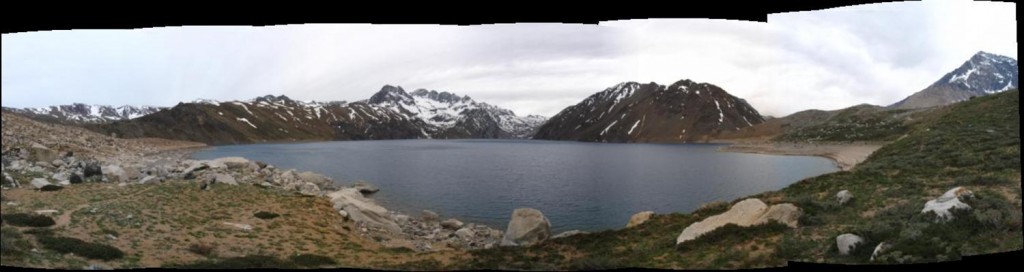
View from the south shore of Laguna Negra. The lake is 6 km long by 1.5 km wide, and 320 m deep.

The Planetary Lake Lander (PLL) team is now actively preparing for the first field deployment, which will take place in Laguna Negra in the Central Andes of Chile between November 26 and December 16, 2011.

North shore

North shore

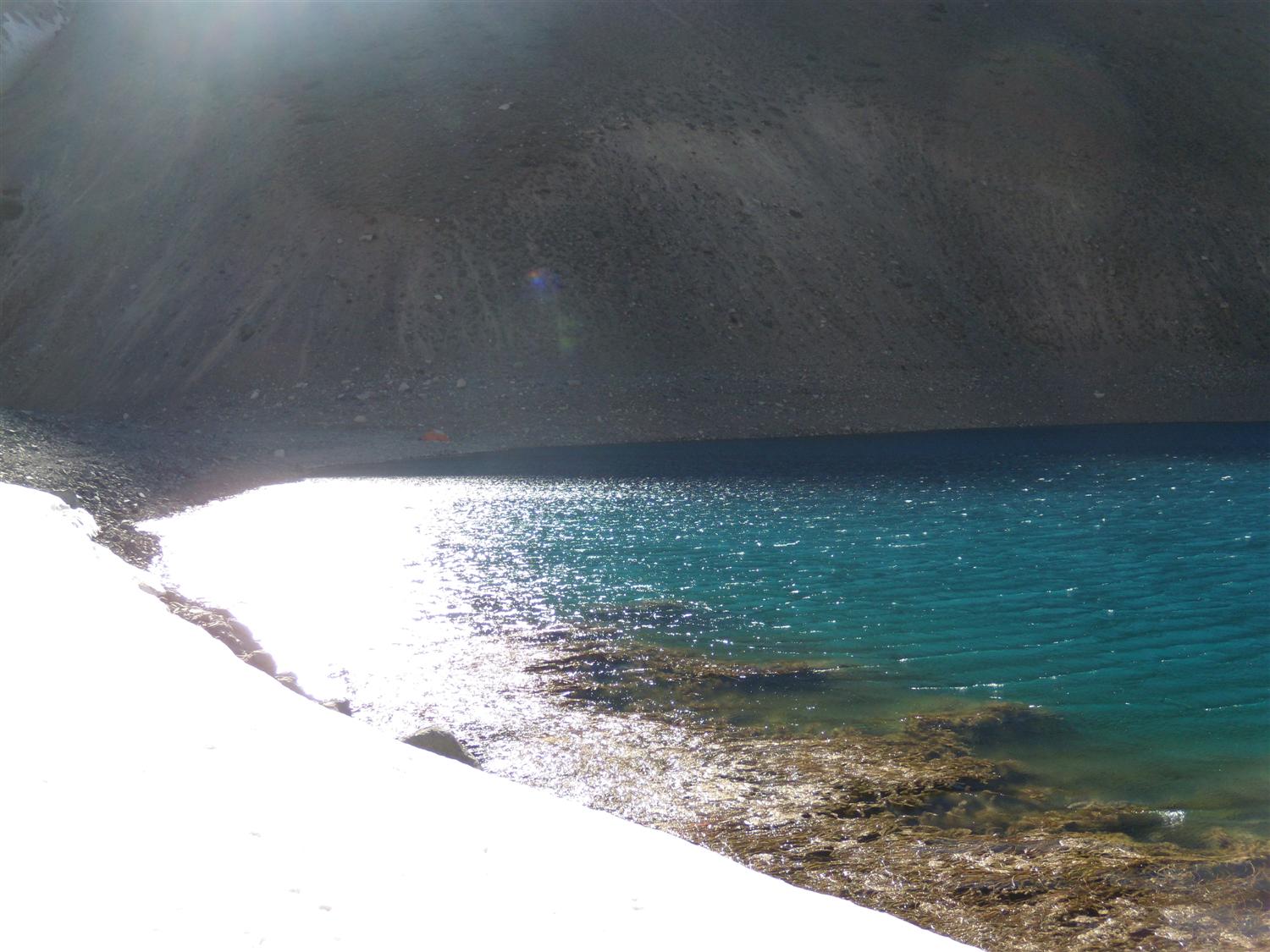
Melt water cascading from the remaining ice towards the lake (North shore)

Smaller lake on the north shore

Pond formation at the edge of melting snow and ice. Northern shore.

All photos are by Cristian Tambley, PLL Project, SETI CSC/NASA Ames/NASA ASTEP